
TL;DR: The History of Wood Flooring
Wood flooring went from a luxury of great houses to an everyday choice in the 1800s, when steam-powered mills made boards cheap to cut. The key facts:
- How long wood takes to grow: oak is typically harvested at 80 to 150 years, black walnut at 50 to 80, and bamboo, a grass, at 5 to 7.
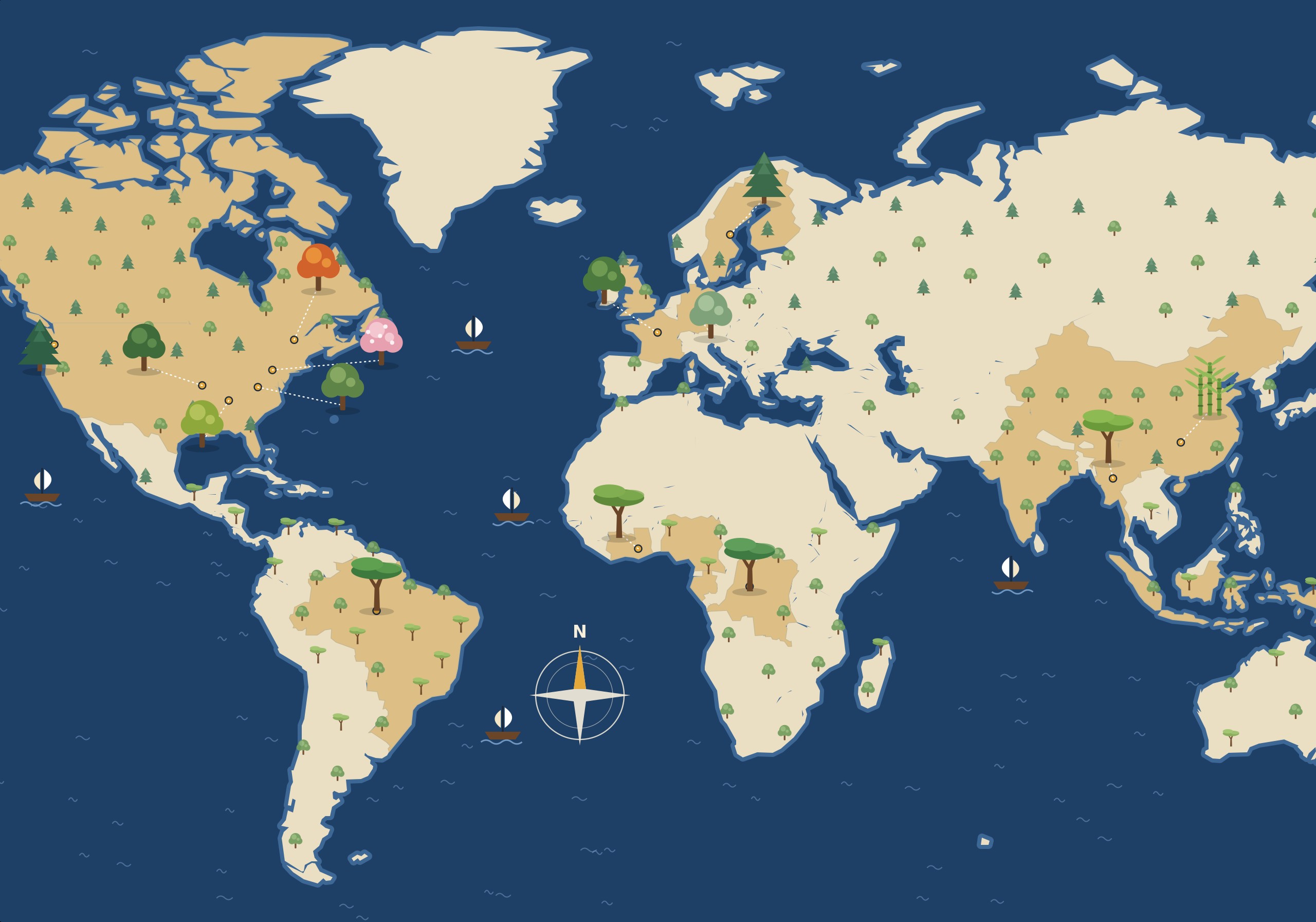
- Where it grows: European oak comes mainly from France, England and Germany, American white oak from the Appalachians and eastern USA, and teak from Myanmar, India and Indonesia.
- What grain is: the pattern of a tree’s growth rings and fibres, which changes with the cut: plain-sawn boards show arching cathedral patterns, quarter-sawn boards show straighter lines.
- Best choice for most homes: engineered oak, which has a real wood top layer on a layered core and suits underfloor heating. Solid wood suits floors you plan to sand many times.
- How much to buy: measure the room and add around 10% for waste, or 15% for herringbone and chevron.
Wood flooring has gone from a luxury of great houses to the most-wanted floor in British homes, and every board still began as a tree that grew for decades. This guide traces the history of wood flooring, shows where the main flooring woods grow, explains how many years each takes to mature, and decodes what the grain is telling you.
What you will learn in this guide
- A timeline of wood flooring from medieval rushes to Versailles parquet, Victorian mills and engineered boards
- A table of 14 flooring woods with where they grow, years to mature and Janka hardness
- What wood grain is and how plain-sawn, quarter-sawn and rift-sawn cuts differ
- How to choose between engineered, solid, herringbone and chevron flooring
- How to work out how much flooring to order
- Answers to 10 common questions, from how long oak takes to grow to whether wood flooring is sustainable
The guide is for homeowners choosing a floor, and anyone curious about the trees behind it.
Wood flooring has gone from a luxury of great houses to the most-wanted floor in British homes, and every board still began as a tree that grew for decades. This guide traces the history of wood flooring, shows where the main flooring woods grow, explains how many years each takes to mature, and decodes what the grain is telling you.
Where flooring woods grow
- European oak, France, England & Germany. Typically matures in 80 to 150 years. Cut along the log, its rays shimmer as silver flecks.
- American white oak, The Appalachians & eastern USA. Typically matures in 80 to 120 years. Its pores seal shut, so it holds whisky and blocks water.
- American black walnut, Missouri & the US Midwest. Typically matures in 50 to 80 years. Naturally chocolate-brown heartwood; no stain needed.
- Hard maple, Quebec, Ontario & the Great Lakes. Typically matures in 60 to 80 years. Tough enough for courts; rare bird's-eye figure is prized.
- Hickory, Tennessee & the American South. Typically matures in 50 to 70 years. Among the hardest US timbers; pale and dark boards clash.
- American cherry, Pennsylvania & the north-east. Typically matures in 50 to 80 years. Starts pale pink, deepens to red-brown in sunlight.
- Douglas fir, The Pacific Northwest, USA & Canada. Typically matures in 60 to 100 years. Huge trunks, very long boards; flame-like grain.
- Nordic pine, Sweden, Finland & the Baltic. Typically matures in 80 to 120 years. Slow northern growth packs the rings into fine stripes.
- European ash, Britain & central Europe. Typically matures in 40 to 70 years. Flexible and shock-resistant; classic tool-handle wood.
- Iroko, Ghana, Ivory Coast & West Africa. Typically matures in 70 to 100 years. Cuts golden, deepens with age; nicknamed African teak.
- Wenge, DR Congo, Gabon & Cameroon. Typically matures in 70 to 100 years. Dark chocolate with near-black veins; very dense.
- Teak, Myanmar, India & Indonesia. Typically matures in 25 to 80 years. Oily and water-resistant; it decked ships for centuries.
- Bamboo, Hunan & Zhejiang, China. Typically matures in 5 to 7 years. A grass, not a tree; some species grow a metre a day.
- Jatoba, The Amazon basin, Brazil. Typically matures in 60 to 100 years. Sold as Brazilian cherry, yet no cherry; darkens in light.
How we came to walk on wood
- Medieval: Floors are mostly earth, stone and rushes. Sawn boards are kept for halls and upper rooms.
- 1500s: Tudor houses lay broad oak boards, sawn by hand in saw pits.
- 1680s: Louis XIV's Versailles makes oak parquet panels the height of fashion.
- 1700s: Georgian homes use softwood boards, often painted or covered with floorcloths.
- 1800s: Steam-powered mills cut tongue-and-groove boards and herringbone blocks for ordinary homes.
- 1920s: Oak strip and parquet blocks spread through new suburban houses.
- 1941: Swedish maker Kährs develops the multi-layer engineered board.
- 1990s: Click-fit locking systems arrive and floors become a DIY job.
- Today: Wide engineered planks, herringbone and chevron are back, with certified timber.
Use the interactive map above to explore 14 woods, from European oak to Amazonian jatoba, then read on for the story behind them.
A short history of wood flooring
Wood flooring has been a status symbol for centuries, and it only became an everyday choice when machines made boards cheap to cut.
- Medieval period: Most floors were earth, stone or strewn rushes. Sawn timber boards were reserved for upper rooms and grand halls.
- 1500s, the Tudor era: Broad oak boards, cut by hand in saw pits, appeared in wealthier houses.
- 1680s, Versailles: Louis XIV’s palace made oak parquet panels the height of fashion. The herringbone layout, known in French as point de Hongrie, spread across European palaces and townhouses.
- 1700s, the Georgian era: Town houses used softwood boards, often painted or covered with floorcloths and rugs.
- 1800s, the Victorian era: Steam-powered mills cut tongue-and-groove boards and parquet blocks in volume, bringing wood floors to ordinary homes.
- 1920s and 1930s: Oak strip and parquet blocks became a feature of new suburban houses.
- 1941: Swedish maker Kährs says it developed the first multi-layer engineered board, the ancestor of today’s engineered flooring.
- 1990s: Click-fit locking systems turned laying a floor into a job many homeowners could do themselves.
- Today: Wide engineered planks, herringbone and chevron patterns are back, and buyers increasingly ask where the timber was grown and whether the forest is managed responsibly.
Types of wood flooring, where they grow and how long they take to mature
Most hardwood floors come from trees that grow for between 50 and 150 years, while bamboo, a giant grass, matures in about 5 to 7. The table lists 14 flooring woods, with typical harvest ages and Janka hardness, which measures the force needed to press a steel ball halfway into the wood. Figures are approximate and vary by forest, growth rate and cut.
| Wood | Where it grows | Typical years to mature | Janka hardness (lbf) |
|---|---|---|---|
| European oak | France, England, Germany | 80 to 150 | 1,360 |
| American white oak | Appalachians, eastern USA | 80 to 120 | 1,360 |
| American black walnut | Missouri and the US Midwest | 50 to 80 | 1,010 |
| Hard maple | Quebec, Ontario, Great Lakes | 60 to 80 | 1,450 |
| Hickory | Tennessee and the American South | 50 to 70 | 1,820 |
| American cherry | Pennsylvania and the north-east USA | 50 to 80 | 950 |
| Douglas fir | Pacific Northwest, USA and Canada | 60 to 100 | 660 |
| Nordic pine | Sweden, Finland, the Baltic | 80 to 120 | 380 |
| European ash | Britain and central Europe | 40 to 70 | 1,320 |
| Iroko | Ghana, Ivory Coast, West Africa | 70 to 100 | 1,260 |
| Wenge | DR Congo, Gabon, Cameroon | 70 to 100 | 1,930 |
| Teak | Myanmar, India, Indonesia | 25 to 80 | 1,155 |
| Bamboo | Hunan and Zhejiang, China | 5 to 7 | 1,380 |
| Jatoba | Amazon basin, Brazil | 60 to 100 | 2,350 |
Why oak dominates the British market
Oak is hard enough for busy homes, takes stain and oil well, and has a grain that suits both rustic and refined looks. European oak is also grown in the same temperate climate as the houses it ends up in, which keeps its movement with the seasons predictable. At Under The Feet our wood range is built around engineered, solid and parquet oak.
Why age matters
A tree that grows slowly lays down tight, even growth rings. That tends to give denser, more stable boards, which is why slow-grown northern pine and old-forest oak are prized. Fast-growing woods are not worse, but they behave differently: bamboo is very hard once laminated and pressed, while quick-grown softwoods dent more easily.
How an engineered floor makes the forest go further
An engineered board uses a thin layer of premium hardwood on a layered core, so a single log yields far more floor than it would as solid planks. That is one reason engineered flooring is a sensible choice when a species takes 80 years or more to grow.
What is wood grain, and what does it tell you about a floor?
Grain is the pattern left by a tree’s growth rings and fibres when the log is sawn into boards, and how the log is cut changes its look more than almost anything else. In temperate trees such as oak, each ring marks one year of growth, so a tight, even ring pattern points to slow, steady growth.
| Cut | What you see | Good to know |
|---|---|---|
| Plain-sawn | Arching, cathedral-shaped patterns | The most common cut and the most varied look |
| Quarter-sawn | Straighter lines, and in oak silvery ray flecks | More stable across the width of the board |
| Rift-sawn | Tight, straight, even lines | Often used for a calm, linear look |
Features that make each floor unique
- Knots mark where a branch once grew. Rustic grades keep them for character; prime grades have fewer.
- Heartwood and sapwood differ in colour. Pale sapwood next to darker heartwood gives the colour variation people love in oak and walnut.
- Rays are the flecks running across oak. They are most visible in quarter-sawn boards.
- Figure such as bird’s-eye in hard maple is rare and prized.
Grain also affects how a floor behaves. Wood moves mostly across its width as humidity changes, which is why layered engineered boards, with their cross-laid core, stay more stable than a single piece of solid timber.
Why no two floors match
Each tree grows through its own sequence of wet years, dry years and crowded or open ground, and the grain records it. Two boards cut from the same log can look different, which is why it pays to mix boards from several packs as you lay a floor.
How to choose a wood floor today
For most homes, engineered oak is the practical choice, with solid wood and parquet suited to particular looks and budgets. The options differ in construction, pattern and how many times they can be refinished.
| Option | What it is | Best for |
|---|---|---|
| Engineered wood | Real hardwood top layer on a layered core | Underfloor heating, rooms with changing humidity, wide planks |
| Solid wood | One piece of timber from top to bottom | Traditional installs and floors you may sand many times |
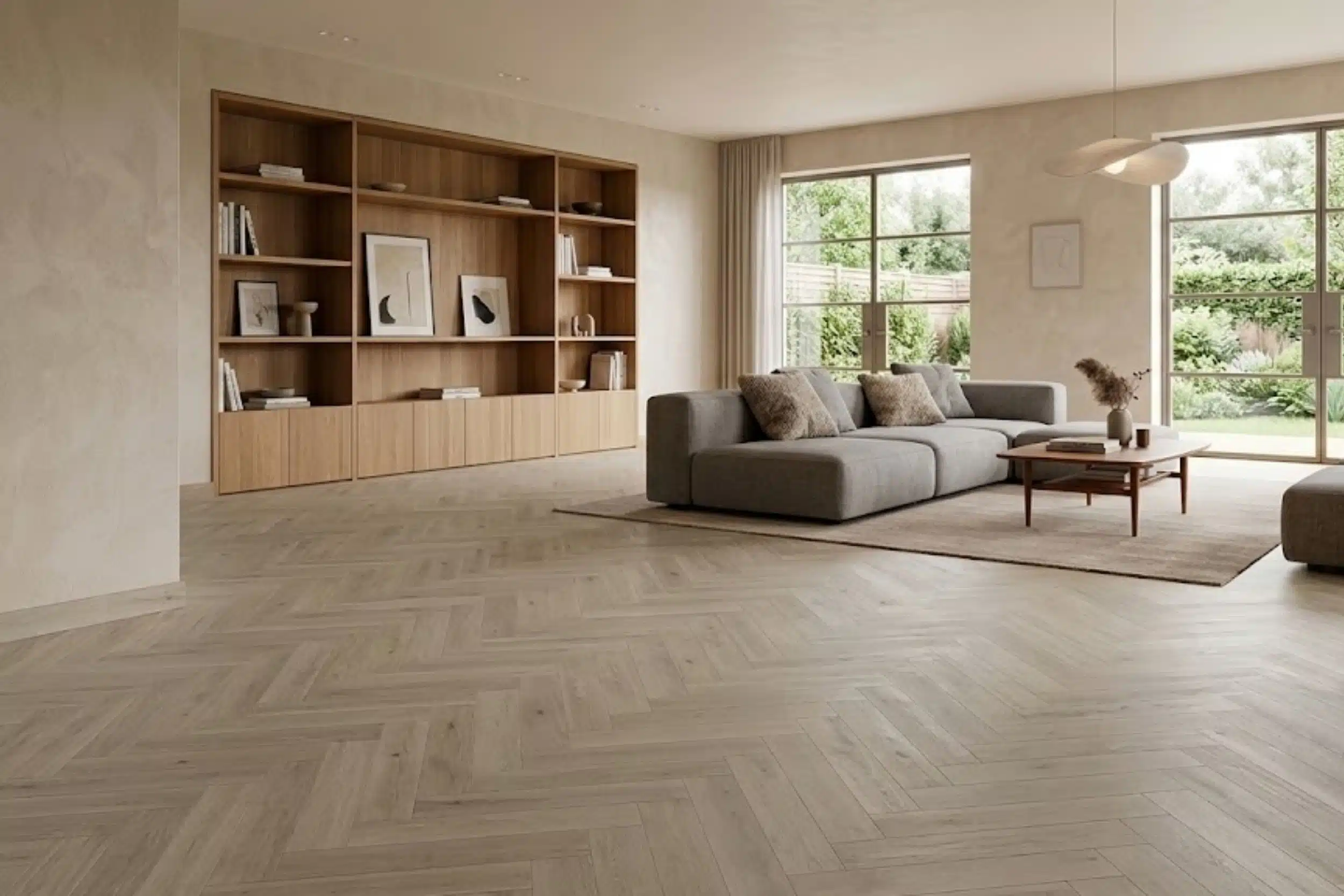
| Parquet and herringbone | Short blocks laid in a broken zigzag | A classic, period-style pattern |
| Chevron | Angle-cut planks that meet in a continuous V | A sharper, more graphic pattern |
What the numbers in a product listing mean
On an engineered board listed as 14mm x 3mm x 190mm, the figures are normally the overall thickness, the thickness of the real wood wear layer and the plank width. A thicker wear layer can be refinished more times, and a wider plank shows more of the grain.
Sustainability
Wood is renewable when forests are managed responsibly, so ask where the timber was grown and look for FSC or PEFC certification. Under The Feet says it only supplies sustainable wood flooring.
How much flooring do you need?
Measure each room and add around 10% for cutting waste, or 15% for herringbone and chevron patterns. Our room flooring estimator does the sums for you: choose your room shape, enter the measurements and it shows how much to order.
See the grain for yourself
Photographs only tell half the story. You can order free samples to see the colour and grain in your own light, and our flooring guides and installation guides cover the next steps.
Frequently Asked Questions (FAQs)
How long does it take for an oak tree to grow before it can become flooring?
Oak grown for quality timber is typically harvested at 80 to 150 years old, depending on species, soil and how the forest is managed. Slow growth packs the rings tightly, which gives stable, fine-grained boards. Faster-growing materials such as bamboo mature in roughly 5 to 7 years.
When did wood flooring become common in British homes?
Wood boards appeared in grand houses from the Tudor period, but they only reached ordinary homes in the 1800s, when steam-powered mills cut tongue-and-groove boards cheaply. Oak strip and parquet floors then spread through new suburban houses in the 1920s and 1930s.
What is the difference between engineered and solid wood flooring?
Solid wood flooring is one piece of timber from top to bottom, while engineered flooring has a real wood top layer bonded to a layered core. Engineered boards are more stable when humidity changes and suit underfloor heating, while thick solid planks can be sanded more times over their life.
Is engineered wood flooring real wood?
Yes. Engineered flooring has a top layer, called the wear layer, cut from real oak or another hardwood, bonded to a layered core of wood-based board. A thicker wear layer, such as 4mm or 6mm, can be refinished more times than a thin one.
Where does oak flooring come from?
European oak flooring is mainly grown in temperate forests across Europe, with France and Germany among the well-known sources, while American white oak comes from the Appalachians and eastern United States. Ask your supplier for the country of origin and certification of any floor you buy.
What is wood grain and why does it vary from board to board?
Grain is the pattern made by a tree’s growth rings and fibres as they are cut. Boards from the same tree look different depending on how the log was sawn: plain-sawn boards show arching cathedral patterns, while quarter-sawn boards show straighter lines and, in oak, silvery ray flecks.
What is the difference between herringbone and chevron flooring?
Herringbone uses rectangular blocks with square-cut ends that sit side by side in a broken zigzag. Chevron planks are cut at an angle, usually 45 or 60 degrees, so their ends meet in a continuous V shape with no break.
Can you lay wood flooring over underfloor heating?
Yes, in most cases, and engineered wood is usually the safer choice because its layered core handles temperature changes better than solid wood. Check the manufacturer’s guidance, as many limit the floor surface temperature to around 27°C, and bring the heating up gradually.
What is the hardest wood for flooring?
Hardness is measured on the Janka scale. Of the woods on our map, jatoba (about 2,350 lbf) and wenge (about 1,930 lbf) rank highest, and ipe is harder still at around 3,500 lbf. Oak, at roughly 1,300 lbf, is hard enough for busy family homes.
Is wood flooring sustainable?
It can be when the timber comes from responsibly managed forests, where trees are replanted and harvested at maturity. Look for FSC or PEFC certification and ask where the wood was grown. Under The Feet says it only supplies sustainable wood flooring.







0 Comments