
TL;DR: The Comprehensive Guide to Sanding Engineered Hardwood
The Core Factor: The number of times you can sand an engineered floor is entirely dictated by its lamella (wear layer) thickness, not the overall board thickness.
The Refinishing Maths: A standard professional sand-and-refinish cycle removes roughly 0.5 mm to 1.0 mm of wood veneer.
Sanding Potential Matrix: * 1.5 mm–2 mm Wear Layer: 0 to 1 times (requires ultra-conservative screening; high risk of burn-through).
3 mm Wear Layer: 1 to 2 times over its lifespan.
4 mm Wear Layer: 2 to 3 times (the residential “sweet spot”).
6 mm Wear Layer: 4 to 5 times (comparable to solid hardwood longevity).
The Hard Limit: You can never sand down to the absolute bottom of the wear layer. You must leave a minimum buffer of 1.0 mm of real wood above the tongue-and-groove joint or core profile to maintain structural integrity and prevent core exposure.
Pro Prevention: Deep mechanical drum sanding should be avoided unless dealing with severe damage. For routine refreshing, use a screen-and-recoat (buffing) process, which abrades only the top lacquer or polyurethane layer without sacrificing precious timber veneer.
Understanding Wear Layers: How Many Times Can You Sand Your Engineered Floor?
Engineered hardwood flooring represents a triumph of modern wood engineering. Composed of a real hardwood top layer—known as the lamella or wear layer—fused to a multi-ply wood or High-Density Fibreboard (HDF) substrate, it delivers the timeless organic beauty of timber with significantly superior dimensional stability compared to solid wood.
However, unlike solid timber planks that can be planed down repeatedly, an engineered board has a finite life cycle determined entirely by its upper wear layer. This article provides an exhaustive, forensic breakdown of the material science, architectural metrics, and mechanical parameters that dictate how many times an engineered floor can be safely sanded and refinished.
1. The Anatomy of an Engineered Plank
To understand the boundaries of refinishing, one must first analyse the structural composite of an engineered board.
-
Top Surface Finish: Factory-applied coatings, typically consisting of 5 to 7 layers of UV-cured polyurethane, aluminium oxide, or natural oxidising oils.
-
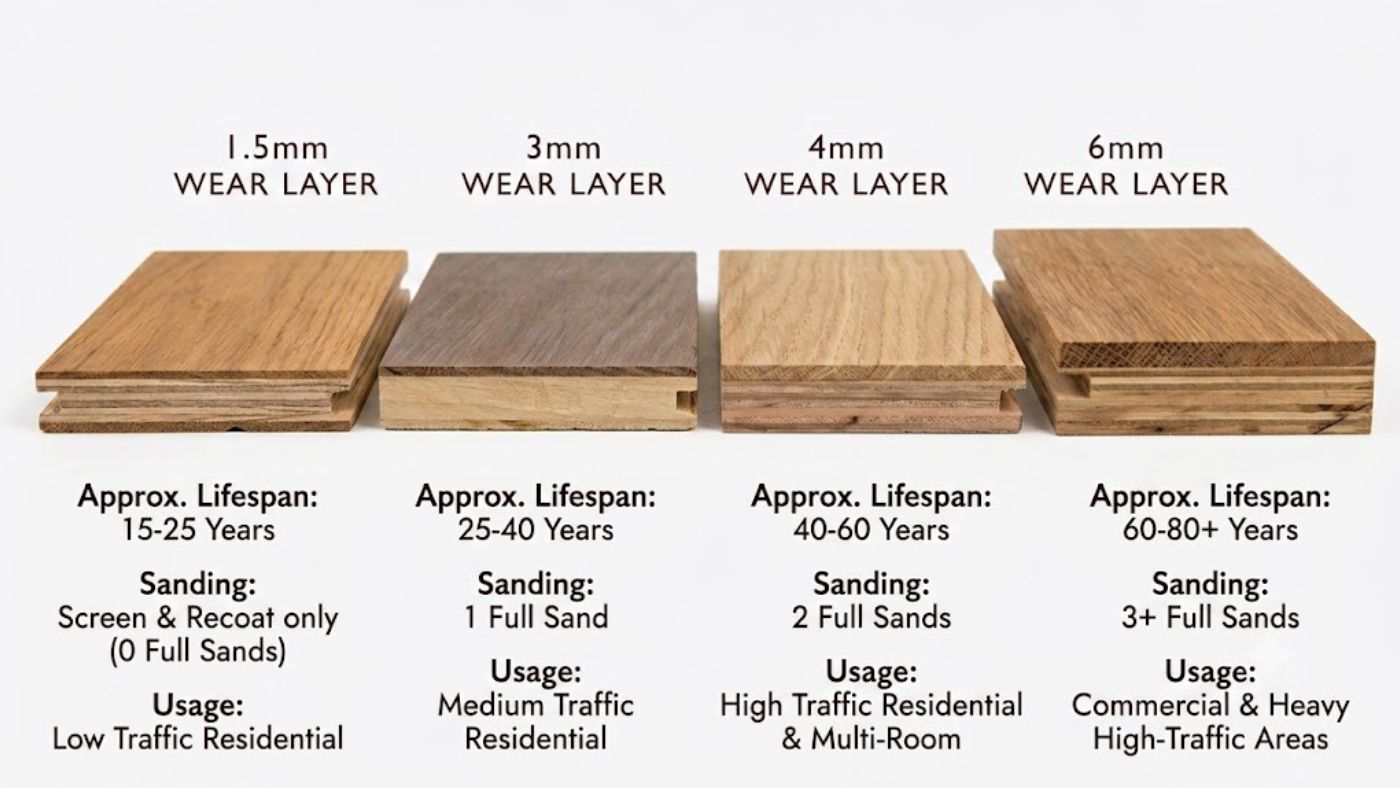
The Lamella (Wear Layer): A solid slice of premium hardwood (such as Oak, Walnut, or Maple). This is the only part of the board that can be mechanically abraded. This ranges from 1.5 mm to 6.0 mm and represents the sandable zone.
-
The Core Bond Line: A high-strength adhesive layer utilising Polyurethane (PUR) or Melamine-Urea-Formaldehyde (MUF) glue under immense hydraulic pressure.
-
The Core or Substrate: Usually made of 9 to 13 layers of cross-laminated marine-grade birch plywood or a compressed HDF core. The grain orientation alternates by 90 degrees in each layer to counteract wood’s natural tendency to warp, expand, or contract. This is the structural integrity zone and is completely non-sandable.
-
The Backing Veneer: A balancing layer of timber on the bottom of the plank (roughly 1.0 mm) that mirrors the tension of the top lamella, ensuring the board stays perfectly flat.
2. Structural Metrics: Wear Layer Thickness vs. Lifespan
The architectural industry categorises engineered floors into distinct quality tiers based on the lamella thickness. The data below details the life expectancy, maximum sand cycles, and thermal resistance implications for each tier.
Wear Layer Technical Specification Breakdown
0.6 mm to 1.2 mm Wear Layer
-
Total Board Depth: 8 mm to 10 mm
-
Max Safe Sand Cycles: 0 (Buffing and recoating only)
-
Residential Lifespan: 10 to 15 Years
-
Commercial Lifespan: Not Recommended
-
Thermal Resistance: Approx. 0.08 to 0.10 m²K/W
2.0 mm Wear Layer
-
Total Board Depth: 10 mm to 12 mm
-
Max Safe Sand Cycles: 0 to 1 (Ultra-light, conservative pass)
-
Residential Lifespan: 15 to 25 Years
-
Commercial Lifespan: 3 to 5 Years (Light use only)
-
Thermal Resistance: Approx. 0.10 to 0.11 m²K/W
3.0 mm Wear Layer
-
Total Board Depth: 14 mm to 15 mm
-
Max Safe Sand Cycles: 1 to 2
-
Residential Lifespan: 25 to 40 Years
-
Commercial Lifespan: 10 to 15 Years
-
Thermal Resistance: Approx. 0.11 to 0.13 m²K/W
4.0 mm Wear Layer
-
Total Board Depth: 15 mm to 18 mm
-
Max Safe Sand Cycles: 2 to 3
-
Residential Lifespan: 40 to 60 Years
-
Commercial Lifespan: 20 to 25 Years
-
Thermal Resistance: Approx. 0.13 to 0.15 m²K/W
6.0 mm Wear Layer
-
Total Board Depth: 18 mm to 21 mm
-
Max Safe Sand Cycles: 4 to 5
-
Residential Lifespan: 60 to 80+ Years
-
Commercial Lifespan: 35 to 50 Years
-
Thermal Resistance: Approx. 0.15 to 0.18 m²K/W
3. The Maths of Refinishing: The “Burn-Through” Threshold
Why does a sand cycle remove the amount of timber it does? When a floor is mechanically refinished, the goal is to remove scratches, dents, and oxidised finishes to expose raw, clean timber.
The Mechanics of Material Removal
-
Heavy Drum Sanding: Utilising an industrial 220V belt sander loaded with heavy 36-grit or 40-grit silicon carbide paper will effortlessly strip away 0.5 mm to 0.75 mm of timber on the first pass alone. Subsequent finer passes (60-grit, 80-grit, up to 100-grit or 120-grit) remove another 0.25 mm. Thus, a full restorative sand down to raw wood deletes roughly 1.0 mm of the lamella.
-
The Structural Buffer Rule: You can never sand down to the exact millimetre where the hardwood meets the core. The top of the tongue-and-groove joint or the locking mechanism rests roughly 1.0 mm above the top edge of the core. If you sand within 1.0 mm of the core bond line, the remaining timber veneer becomes structurally unstable. It will lose its shear strength, begin to splinter, flake away, or mirror the adhesive line underneath, rendering the floor a total failure.
The Math Formula: Maximum Sandable Timber equals Total Lamella Thickness minus 1.0 mm (Structural Buffer).
For example, on a 3.0 mm wear layer floor, subtracting the 1.0 mm buffer leaves exactly 2.0 mm available for sanding. At 1.0 mm removed per heavy sand cycle, this floor allows exactly 2 sand cycles before hitting structural end-of-life.
4. Screening vs. Full Sanding: Preserving the Wear Layer
To optimise the lifespan of an engineered floor, it is critical to diagnose whether the floor requires a Full Refinish or a simple Screen-and-Recoat.
The Diagnostics Process
-
Is the damage through the wood? If there are deep gouges, heavy pet stains, or bare timber showing, you must opt for a Full Sand & Refinish. This removes around 1.0 mm of wood and exposes fresh, raw timber.
-
Is the damage only on the surface? If the wood underneath is undamaged, but the factory topcoat is hazy, scuffed, or dull, you do not need a drum sander. Instead, use a Screen and Recoat procedure.
The Screen-and-Recoat Procedure (The Wear Layer Saviour)
A professional will use a rotary floor buffer equipped with a fine abrasive mesh screen (typically 120-grit to 150-grit). This process merely abrades the top microscopic layers of polyurethane lacquer, creating a mechanical profile for a fresh topcoat of lacquer to adhere to. A screen-and-recoat removes 0 mm of the timber wear layer, allowing you to revive your floors repeatedly without shortening their structural lifespan.
The Lamella Lifecycle: Engineered Wood Sanding Limits
| Lamella (Wear Layer) | Max Safe Sand Cycles | Est. Residential Lifespan | Refinishing Risk Level |
|---|---|---|---|
| 1.5 mm – 2.0 mm | 0 to 1 Times | 15 – 25 Years | High (Burn-through risk) |
| 3.0 mm | 1 to 2 Times | 25 – 40 Years | Moderate |
| 4.0 mm | 2 to 3 Times | 40 – 60 Years | Low (The Sweet Spot) |
| 6.0 mm | 4 to 5 Times | 60 – 80+ Years | Very Low |
Frequently Asked Questions
1. How do I determine my wear layer thickness if I don’t have the original paperwork? The most reliable, non-destructive method is to remove an architectural element where a cross-section of the floor is exposed. Pry up a wall-base moulding, a transition threshold at a doorway, or remove a floor heating vent cover. Use a precise digital caliper to measure only the top, distinct hardwood veneer layer running above the plywood plies.
2. Can you sand an engineered floor that has been floated over an underlay? Yes, but it requires extreme mechanical care and professional calibration. Floating floors rest on an elastic underlay, meaning they flex slightly under pressure. If a heavy drum sander is pushed across a flexing floor, the sander can create waves, dips, or gouge deeply into the plank. To safely sand a floated floor, a multi-disc rotary sander must be used instead of a traditional heavy drum belt sander.
3. What is “core exposure” (or “over-sanding”), and can it be repaired? Core exposure occurs when the sanding machine cuts completely through the lamella, exposing the cross-grained plywood or HDF substrate below. It looks like a patchy, pale, or striped blemish that cannot absorb stain uniformly. It cannot be structurally or cosmetically repaired. The only remedy is to cut out the compromised planks and splice in fresh replacement boards from the original manufacturing batch.
4. Does the wood species alter how many times a floor can be sanded? Absolutely. The Janka Hardness Rating of the wood species drastically changes the material removal rate. A dense hardwood like Canadian Hard Maple or Brazilian Cherry resists abrasion, requiring slower, more calculated sanding passes. Conversely, a soft timber like American Walnut or Douglas Fir shreds incredibly fast; an inexperienced technician can accidentally burn through a 3 mm Walnut wear layer in seconds.
5. Can engineered floors with a beveled edge be sanded back to square? Yes. Micro-bevels or deep V-grooves run along the edges of planks to hide minor subfloor inconsistencies. When you fully sand an engineered floor, you are leveling the entire surface flat. This will naturally shave down and erase micro-bevels. If the floor has deep bevels and you wish to remove them completely, it requires a deeper sand pass (removing up to 1.2 mm), which consumes more of your precious wear layer allowance.
6. Can you sand hand-scraped, wire-brushed, or distressed engineered floors? You can, but doing so completely erases their premium textured character. Hand-scraped or wire-brushed textures create hills and valleys in the wood. To refinish them, a sander must grind down the “hills” until they match the depth of the lowest “valleys.” This process consumes a significant portion of the wear layer—often up to 1.5 mm—instantly sacrificing one to two future sand cycles.
7. How does a factory-applied Aluminium Oxide finish affect the sanding process? Aluminium oxide is one of the hardest mineral coatings on Earth, designed to prevent scratches. It is notoriously brutal on sanding equipment. Attempting to sand it off with standard sandpaper will simply glaze over the grit and dull the paper instantly. Professionals must use premium ceramic or diamond-grit abrasive discs to crack and strip the aluminium oxide shell before they can even touch the raw wood veneer below.
8. Does underfloor heating (UFH) affect the sanding parameters? Indirectly, yes. Engineered floors over hydronic or electric UFH undergo continuous, low-level thermal cycling. This can make the wood slightly more brittle and dry. Before executing a sand-and-refinish cycle on a UFH-backed floor, the heating system must be deactivated for a minimum of 48 hours prior to sanding to ensure the wood is stabilised at a natural room temperature.
9. Can I change the colour of my engineered floor during a sand cycle? Yes, this is one of the primary benefits of a full sand. Once the drum sander removes the existing clear coat and old stain, exposing raw timber, you can apply a completely new penetrating oil or reactive stain. This allows you to transform a dark, outdated walnut aesthetic into a modern, neutral, light Scandi-oak appearance.
10. How long must I wait after a full sand and finish before moving furniture back? This is entirely dictated by the curing chemistry of the chosen finish.
Water-Based Polyurethane: Can handle light foot traffic in 4 to 6 hours, but requires 7 full days to reach maximum chemical hardness and a 100% cure.
UV-Cured On-Site Oils: Cure instantly under specialised high-intensity portable UV light rigs.
Natural Oxidising Oils: Require 24 to 48 hours before any foot traffic and up to 14 days before rugs can be laid back down. Moving heavy furniture prematurely will cleave the fresh coat and ruin the finish.














0 Comments