
TL;DR: The Quiet Luxury Flooring Blueprint
The Core Aesthetic: “Quiet luxury” rejects high-gloss sheen, flat synthetic greys, and aggressive machine distressing. It favours organic material integrity, subtle surface tactility, and impeccable architectural proportions.
Specification Benchmarks: Wide-plank engineered oak (220 mm–300 mm+ width, up to 2400 mm lengths) or classic English Herringbone in Select or Prime grades, finished with ultramatt invisible oils that preserve the raw timber optic.
Execution & Acoustics: Precision installation via full-bed adhesive bonding (direct-stick) rather than floating. This produces a solid, acoustically dampened step underfoot that eliminates hollow echo—the ultimate sensory signifier of quality.
The “Quiet Luxury” Aesthetic: How to Pick Floors that Look “Quietly Expensive”
In high-end residential architecture and interior design, the era of ostentatious, high-shine luxury is over. Loud exotic woods, high-gloss polyurethane varnishes, and heavily grey-stained synthetic boards are replaced by the “Quiet Luxury” aesthetic.
Rooted in understated elegance, quiet luxury flooring does not demand attention with loud patterns or artificial finishes. Instead, it subtly conveys value through superior raw material selection, refined timber grading, master joinery, and an authentic tactile experience.
Achieving a “quietly expensive” floor requires an understanding of timber grading, chemical finishing, acoustic density, and structural proportion.
1. Architectural Proportions: Scale, Width, and Parquetry
The dimensions of a floorboard immediately signal its quality to the human eye. Mass-produced wood flooring is restricted by yield optimisation, resulting in narrow boards (120 mm–150 mm) with short, chopped lengths (400 mm–1200 mm). Quiet luxury demands scale.
Wide-Plank Proportions
To create an expansive, serene floor plane, board widths should start at 220 mm and extend up to 300 mm or more. Crucially, these wide planks must be paired with continuous long lengths (up to 1800 mm–2400 mm). Long, unbroken boards reduce horizontal end-joints across a room, creating a calm, fluid visual sequence that expands space.
Parquetry: French Chevron vs. English Herringbone
When specifying patterned parquetry, quiet luxury relies on historical proportion rather than oversized commercial blocks:
-
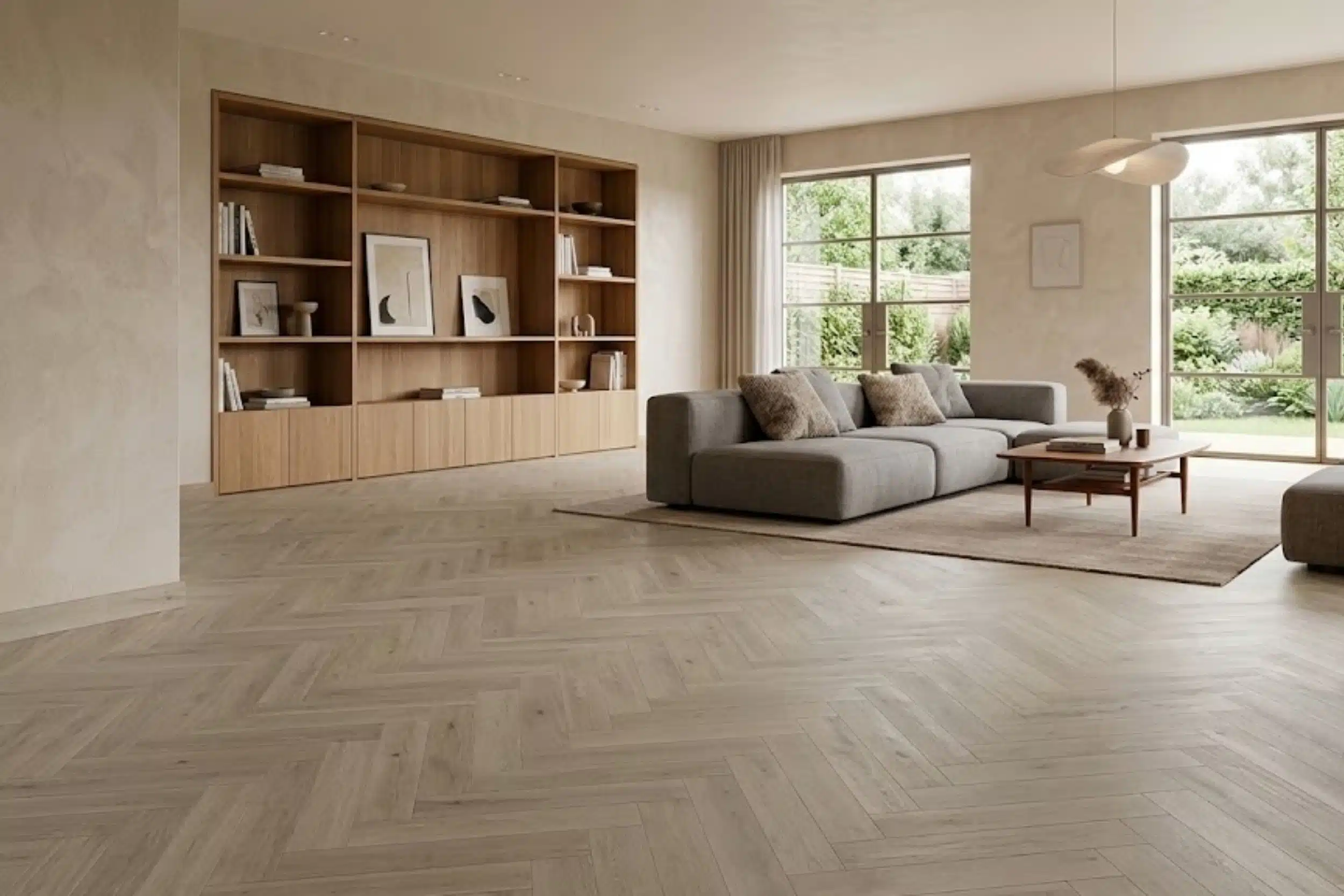
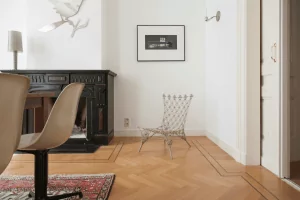
Herringbone: Choose refined block dimensions, such as 90 mm × 450 mm or 100 mm × 500 mm (a 1:5 ratio). Overly massive herringbone blocks often distort room proportions.
-
Chevron: A 45° or 60° angle cut creates precise, clean directional lines. The key is micro-bevelled or square edges that allow the pattern to meet seamlessly without heavy V-shaped dirt channels.
2. Timber Grading Science: The Art of Subtle Grain
Flooring timber is categorised into grades based on the presence of knots, sapwood, and tonal variations: Prime, Select, Character, and Rustic.
Quiet luxury sits precisely in the Select to Light Character spectrum.
Timber Grading Spectrum
-
Why Not Prime? Ultra-clean Prime grade oak can sometimes appear so uniform that it mimics synthetic laminate. It lacks the natural depth necessary for an authentic, organic feel.
-
Why Not Heavy Rustic? Heavily rustic grades contain large filler-filled knot holes, prominent sapwood, and aggressive colour contrast that disrupt room harmony.
-
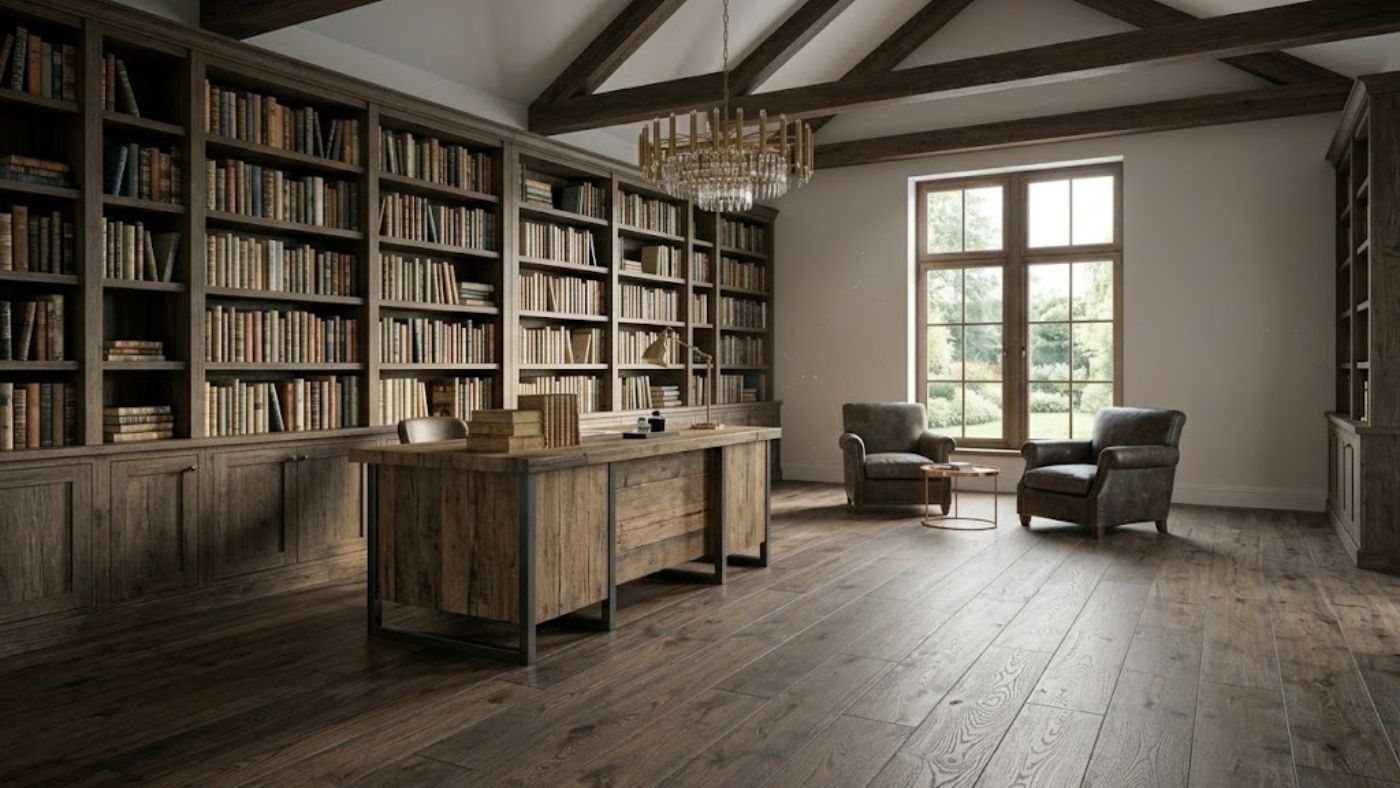
The Quiet Luxury Sweet Spot: Select Grade features tight, linear grain patterns with occasional small, sound knots (under 15 mm) and no visible sapwood along the board edges. This creates an authentic organic look without visual noise.
3. Surface Chemistry: Ultramatt, Reactive Stains, and Invisible Oils
The finish sitting on top of the timber determines how light interacts with the floor. High-gloss and satin lacquers build up a plastic film that reflects light specularly, flattening the natural depth of the grain and highlighting dust and minor scratches.
The Invisible Oil Optic
Quiet luxury relies on ultramatt, penetrating hardwax oils or raw-effect UV oils (achieving a sheen level of 3% to 5%). Modern finishing techniques use trace amounts of white or grey micro-pigments combined with flat-matt silicates to neutralise the natural yellowing of oak. The result is a floor that looks like completely unfinished, raw timber fresh from the saw mill, while being fully sealed against moisture and dirt.
Reactive Stains vs. Pigment Stains
-
Cheap Pigment Stains: Standard wood stains sit on top of the wood surface like a dye, muddying the grain and turning unnatural colours (such as flat cold grey or orange-brown).
-
Deep Reactive Fuming (Smoking): Quietly expensive dark floors achieve their colour through chemical reaction. Fuming introduces ammonia vapour or reactive salts to the timber, which react with the natural tannins inside European Oak. This turns the wood a deep, rich smoke-hazelnut or dark espresso colour from within, leaving the natural grain crisp and transparent.
4. Acoustic Density: The Unseen Marker of Quality
A floor can look stunning, but if it clicks, flexes, or echoes underfoot, the luxury illusion is instantly broken. How a floor feels under weight and sounds under heel is a subtle indicator of quality.
Direct-Stick Elastomeric Bonding
Floating a floor over a lightweight foam underlay creates a hollow acoustic cavity. Footsteps produce a high-pitched click-clack sound, and the floor may bounce slightly over minor subfloor variations.
Quiet luxury flooring requires 100% full-bed elastomeric direct-stick bonding:
-
The subfloor is prepared with a liquid damp-proof membrane (DPM) and smoothed using a heavy-duty fibre-reinforced smoothing compound (screed).
-
A high-shear, permanently flexible Silane-Modified Polymer (SMP) adhesive is combed directly onto the subfloor.
-
The engineered boards are pressed into the adhesive bed.
This installation method fuses the timber directly to the building’s structure. Footfall noise is converted from a hollow, echoey tone into a solid, low-frequency “thud,” mimicking the mass of solid 22 mm hardwood laid in historical estates.
Quiet Luxury vs. Mass Market Flooring Indicators
| Design Element | Quiet Luxury Spec | Mass Market / Dated Spec |
|---|---|---|
| Plank Dimensions | Wide (220mm-300mm+), Long (up to 2400mm) | Narrow (120mm-150mm), Short random lengths |
| Surface Sheen | Ultramatt (3-5% sheen), Raw-effect invisible oil | High-gloss polyurethane or satin varnish |
| Colour Method | Reactive tannins, fumed oaks, organic biscuit tones | Flat surface grey stains, reddish orange varnish |
| Edge Profile | Micro-bevel (0.5mm) or Square edge | Deep oversized V-grooves (accumulate dirt) |
| Acoustics & Feel | Direct-stick adhesive bonded (Solid thud underfoot) | Floating on cheap foam underlay (Hollow echo) |
Frequently Asked Questions (FAQs)
1. What defines “quiet luxury” in wood flooring? Quiet luxury flooring avoids high-gloss sheens, trendy cold-grey stains, and aggressive artificial distressing. It relies on high-grade natural timber, long and wide plank dimensions, ultramatt invisible finishes, and solid acoustic installation that feels grounded underfoot.
2. What wood species is most commonly used for a quietly expensive look? European Oak (Quercus robur) is the industry gold standard. Its tight grain structure, rich natural tannin content, and ability to accept reactive fuming and light organic oiling make it far more adaptable and refined than fast-grown American red oak or soft tropical species.
3. Are grey floorboards considered quiet luxury? No. Cool, flat grey-stained floors are widely associated with mid-2010s mass-market trends. Quiet luxury colour palettes feature warm oat, soft biscuit, natural pale raw oak, or rich, dark reactive-fumed tones that feel timeless.
4. Is engineered wood flooring acceptable for luxury projects? Engineered wood is preferred by high-end interior designers and architects over solid wood. A high-spec engineered plank (featuring a 15 mm–20 mm structural birch plywood core and a 4 mm–6 mm European Oak wear layer) offers superior dimensional stability over underfloor heating while appearing identical to solid timber once installed.
5. How do micro-bevels compare to square edges for a luxury look? Square-edge boards lock together to create a completely smooth visual plane, resembling historical site-finished estate floors. Micro-bevels (a delicate 0.5 mm chamfer) gently define individual planks without trapping dirt, unlike the deep V-grooves found on mass-market laminate boards.
6. Can Luxury Vinyl Tile (LVT) ever look quietly expensive? Yes, provided it is specified carefully. Choose glue-down (dry-back) LVT with an ultramatt wear layer, high-definition register-embossing (where the surface texture perfectly matches the grain pattern below), and no exaggerated bevels. Avoid high-gloss LVT profiles.
7. Why does direct-stick glueing make a floor feel more expensive than floating? Floating floors sit on an air gap over underlay, causing minor vertical movement and a hollow echo when walked on in hard shoes. Direct-stick adhesive bonding secures the plank to the concrete or plywood subfloor, creating a dense acoustic response and a rock-solid step.
8. What is an “invisible oil” finish? An invisible oil is an ultramatt protective finish containing microscopic white pigments and flat silicates. It seals the wood’s pores against stains while eliminating the yellow or amber tint that natural oils often create, preserving the pale look of freshly cut raw oak.
9. How do floorboard lengths affect the look of a room? Short boards (under 1200 mm) create a patchwork effect with numerous vertical seams that break up the space. Long boards (1800 mm–2400 mm) draw the eye along the length of the room, creating an expansive, uninterrupted flow that signals premium raw material selection.
10. How do you clean and maintain an ultramatt quiet luxury timber floor? Clean the floor using a microfibre mop and specialised pH-neutral nourishing wood soap (such as Woca or Osmo). Avoid supermarket degreasers, steam mops, or harsh chemical detergents, as these strip natural oils and leave behind residue that compromises the ultramatt finish.




0 Comments