
The Ultimate Guide to Wood Flooring: Everything You Need to Know
Choosing premium timber flooring is one of the most significant architectural investments you can make for a property. While retail-level overviews touch upon basic styles, selecting a floor that handles the demands of modern properties requires a deep understanding of wood anatomy, manufacturing physics, moisture mechanics, and surface treatments.
This comprehensive guide breaks down every critical technical layer, providing a masterclass in specifying, installing, and maintaining luxury timber floors.
1. Structural Anatomy: Solid vs. Engineered Wood Flooring
The fundamental decision when specifying real timber centers on its core construction. This selection governs the floor’s structural limits, its life expectancy, and its response to ambient atmospheric conditions.
Solid Wood Flooring
Solid wood planks are milled from a single, continuous piece of timber (typically 18mm to 20mm thick) featuring an integrated tongue-and-groove locking profile.
-
The Physics of Solid Timber: Wood is naturally hygroscopic. A solid plank functions like a dense bundle of microscopic straws running lengthwise. When relative humidity (RH) rises, these cell walls absorb airborne water molecules and swell across the width of the board. When RH drops, the cells shrink. Because solid timber has no internal restraint mechanisms, this rhythmic seasonal movement can lead to cupping (edges raising higher than the center), crowning (the center bulging upward), or severe gapping between planks.
-
Refinishing Thresholds: Solid planks offer a generous sandable thickness above the tongue-and-groove joint, allowing them to be sanded down and refinished up to 5–7 times over a lifespan stretching past a century.
-
Subfloor Limitations: Solid timber must never be installed directly over concrete slabs without a robust, specialized subfloor buildup. It is strictly incompatible with underfloor heating systems.
Engineered Wood Flooring
Engineered timber is a highly sophisticated, structurally cross-layered sandwich composed of a real hardwood surface bonded onto a high-performance substrate.
-
The Mechanics of Stability: A premium engineered plank features a top layer of real hardwood (known as the wear layer or lamella), which is hydraulically pressed and permanently bonded to a multi-ply hardwood core or a singular, high-density cross-directional block core. The structural layers beneath the lamella alternate directions by 90 degrees. When environmental moisture prompts the wear layer to swell or contract, the alternating grain vectors of the structural plies mechanically counteract that movement, neutralizing up to 90% of the internal tension.
-
Anatomy of the Lamella: Premium engineered options generally specify a lamella thickness between 3mm and 6mm:
-
3mm wear layer: Offers 1 to 2 lifetime sandings; ideal for standard residential spaces.
-
4mm–5mm wear layer: Offers 3 to 4 lifetime sandings; replicates the refinishing capacity of solid wood while maintaining modern stability.
-
6mm wear layer: Intended for heavy commercial traffic or forever homes, allowing multiple deep structural sandings.
-
-
Climate Resilience: Engineered timber is engineered to withstand the volatile humidity shifts common in maritime climates like the UK, remaining perfectly flat where solid planks would risk structural failure.
2. Hardwood Species & Visual Wood Grading
The choice of timber species establishes the foundational hardness and base color palette of a room, while the selection of the wood grade dictates its visual complexity and architectural character.
Primary Luxury Hardwoods
-
European Oak (Quercus robur): The undisputed gold standard for luxury flooring. European Oak yields a dense, highly stable grain structure with a naturally muted, neutral straw-gold tone. It responds exceptionally well to chemical treatments such as smoking, fuming, and reactive staining, allowing for an endless variety of tailored design aesthetics.
-
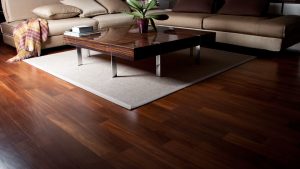
American Black Walnut (Juglans nigra): Renowned for its unparalleled natural opulence, featuring sweeping deep chocolate, espresso, and charcoal-violet heartwood tones mixed with creamy vanilla sapwood accents. Walnut is noticeably softer than Oak on the Janka hardness scale, developing a rich, sought-after patina over time. It is best specified for luxury bedrooms, formal dining rooms, or spaces where raw visual drama takes precedence over heavy high-heel impact resistance.
The Janka Hardness Scale Explained
The Janka scale measures a timber’s mechanical resistance to denting and wear by calculating the exact force required to embed an 11.28mm steel ball halfway into a wood plank:
-
European Oak: ~1,360 lbf (High impact resistance; ideal for heavy commercial and high-traffic family zones).
-
American Walnut: ~1,010 lbf (Softer, luxurious feel; requires mindful care in pet-heavy households).
Deciphering Wood Grades
Wood grading is purely a visual assessment governed by where a plank is cut from the log. It does not affect the structural integrity or density of the floor.
| Grade | Cut Location | Grain Characteristics | Knots & Fillers | Design Aesthetic |
| Prime / Select | Deep heartwood of mature logs | Exceptionally clean, straight, and uniform grain with minimal color variation. | Virtually clear. Occasional pinpoint knots up to 5-10mm. No sapwood allowed. | Sleek, ultra-modern, architectural minimalism and high-end contemporary spaces. |
| Natural / Nature | Intermediate zone of the log | A balanced blend of straight and sweeping cathedral grains with organic color variations. | Medium-sized sound knots (up to 25-30mm), masterfully filled to complement the timber’s base tone. Minimal sapwood bands. | Timeless, authentic luxury that celebrates real wood without dominating the room. |
| Rustic | Outer sections of the log | Maximum organic character. Highly expressive, swirling grains, distinct mineral streaks, and rich tonal variations. | Large sound and filled knots (up to 50mm+), star shakes, and visible sapwood borders. Fillers contrast beautifully with the grain. | Multi-textured warmth. Perfect for barn conversions, country estates, or high-contrast modern-industrial spaces. |
3. Surface Textures & Finish Formulations
The combination of surface texturing and protective topcoating determines how a floor interacts with ambient light, how it feels underfoot, and the level of maintenance it requires.
Mechanical Surface Texturing
-
Brushed (Wire-Brushed): Planks are passed beneath high-speed, heavy-duty wire brush rollers that intentionally scour away the softer summerwood fibers, leaving the dense winterwood growth rings raised and prominent. This process gives the floor a distinct three-dimensional texture that scatters natural light to mask micro-scratches and footprints.
-
Distressed / Hand-Scraped: The surface and bevels are hand-worked or mechanically treated with chisels and gouges to replicate the worn character of centuries-old flooring. This style is highly practical for high-traffic, life-proof spaces, as any new dents or scratches simply blend into the existing artwork.
-
Smooth-Sanded: The timber is calibrated to a perfectly flat, satiny face. This finish provides a crisp, flawless canvas that highlights the pure geometry of the installation.
Advanced Finish Chemistry
-
Natural Oiled Finishes: Curing oils penetrate deep into the timber cells, oxidizing and curing inside the wood to fortify it from within.
-
Benefit: Preserves the raw, breathable, tactile feel of timber underfoot. Micro-scratches can be locally spot-repaired without sanding the entire room.
-
Consideration: Requires periodic re-oiling maintenance every 12–24 months in high-traffic zones to prevent the wood from drying out.
-
-
UV Oiled Finishes: A modern hybrid finish where specialized oils are applied in multiple ultra-thin coats and instantly cured beneath intense industrial ultraviolet light lamps.
-
Benefit: Delivers the organic, low-sheen look of a natural oil but bonds instantly into a tougher, more water-resistant surface layer that does not require immediate post-installation maintenance.
-
-
Matt & Ultra-Matt Lacquered Finishes: Multiple coats of high-performance polyurethane or acrylic resins form a micro-thin protective shield over the timber surface.
-
Benefit: Exceptional defense against liquid spills, cosmetic stains, and heavy scratching. Truly “wipe-clean” and maintenance-free for decades. Modern ultra-matt lacquers are completely non-reflective, neutralizing the artificial plastic shine once associated with old-fashioned varnishes.
-
-
Invisible Finishes (Raw/Bare Wood Effect): An advanced chemical finish formulated with microscopic quantities of white or silver UV-inhibiting pigments mixed into an ultra-matt carrier. This formulation counteracts the ambering “wet look” caused by standard clear oils, preserving the pale, freshly-sanded aesthetic of raw, untreated oak.
4. Architectural Form Factors & Design Configurations
The structural layout of your planks directly influences how perspective, light, and space behave across an interior floor plan.
Straight Wide Plank Flooring
-
Planks run parallel down the length or width of a room.
-
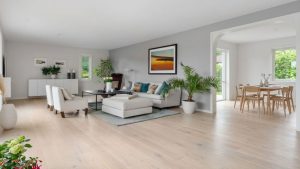
Design Dynamics: Specifying wide boards (190mm to 240mm+) combined with generous lengths (1800mm to 2400mm) reduces the number of visible seams, creating an expansive, continuous look that makes smaller rooms feel significantly larger. Long boards installed toward primary windows naturally guide the eye outward, emphasizing the architecture of the space.
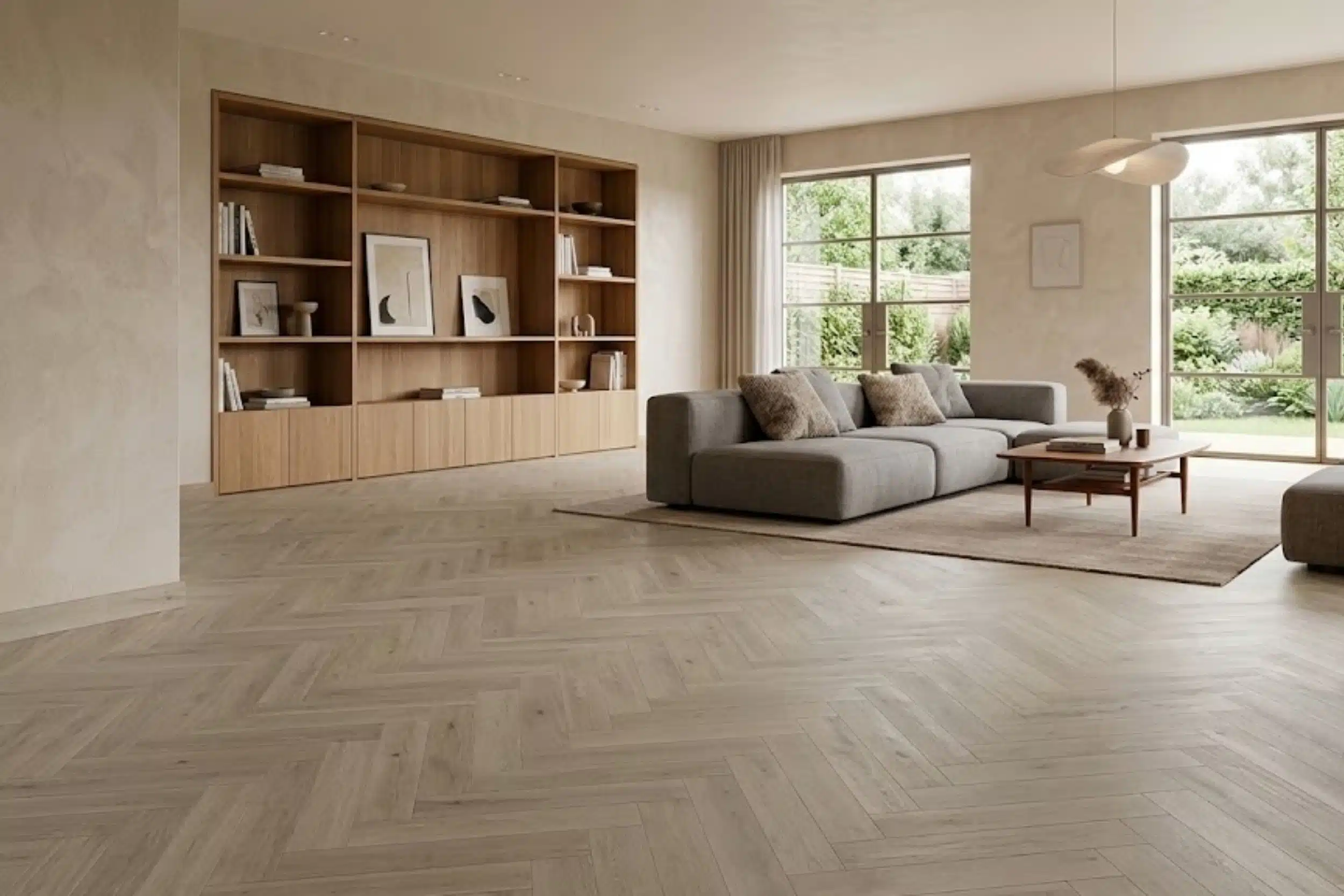
Classic Parquet: Herringbone vs. Chevron
Parquet layouts add historical character and a tailored look to entrance halls, master suites, and formal living areas.
-
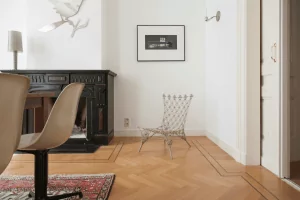
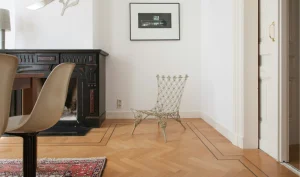
Herringbone: Formed using true rectangular blocks installed at a precise 90-degree angle to one another, with the short end of one block butt-jointed against the long side of the next. This creates a staggered, interlocking zig-zag pattern with a classic aesthetic.
-
Chevron: Cut with a precise mitered profile on both ends of each block (typically at a 45-degree or 60-degree angle). The mitered ends meet flawlessly along a continuous center line, creating a clean arrow or “V” pattern. This alignment yields a sharp, geometric design favored in Parisian apartments and modern architectural spaces.
The Room Compatibility Matrix
Before picking a colour, you must pick a construction. In the UK, factors like damp subfloors or underfloor heating (UFH) dictate your choices.
| Room | Solid Wood | Engineered | Laminate/LVT |
| Lounge & Bedroom | ⭐⭐⭐⭐⭐ | ⭐⭐⭐⭐⭐ | ⭐⭐⭐⭐⭐ |
| Kitchen | ❌ Not Recommended | ⚠️ (Brushed/Lacquered) | ⭐⭐⭐⭐⭐ |
| Bathroom | ❌ Not Recommended | ❌ Not Recommended | ⭐⭐⭐⭐⭐ (Waterproof) |
| Basements/UFH | ❌ Risk of Warping | ⭐⭐⭐⭐⭐ (Stable) | ⭐⭐⭐⭐⭐ |
`
5. Subfloor Physics, Preparation & Installation
A premium wood floor is only as good as the subfloor beneath it. Skipping proper preparation is the primary cause of post-installation failures like creaking, popping, or structural warping.
The Golden Rules of Subfloor Preparation
-
Moisture Equilibrium: Concrete subfloors must be thoroughly tested using a calibrated non-destructive impedance meter or a pin-type hygrometer. Liquid concrete or sand-cement screeds must register below 75% Relative Humidity (RH) or under 0.5% CM (Carbide Method) before installation. If readings are higher, a heavy-duty liquid epoxy damp-proof membrane (DPM) must be rolled across the subfloor to block rising vapor.
-
Structural Leveling: The subfloor must be flat within a tolerance of +/- 2mm over a 3-meter continuous radius. Any localized high spots must be ground down mechanically, and low valleys must be filled using a high-compressive-strength cementitious self-leveling compound.
-
Rigidity and Cleanliness: Existing wooden subfloors must be securely screwed down to eliminate structural deflection (bounce). The entire surface must be thoroughly vacuumed to remove any drywall dust, drywall compounds, or paint residues that could compromise adhesive bonds.
Installation Methodologies
Fully Bonded (Glue-Down)
The engineered or solid planks are adhered directly to the subfloor using a heavy-duty, permanently flexible silane-modified polymer (MS Polymer) troweled adhesive.
-
Why use it: This is the premium standard for high-end properties. It creates a solid sound underfoot, eliminating the hollow “click-clack” noise associated with floating floors. It optimizes thermal transfer efficiency for underfloor heating and allows for seamless transitions to adjacent tiles or stone finishes without needing bulky threshold profiles.
Floating (Underlayment System)
Planks are locked together along their tongue-and-groove or click edges and laid freely over a specialized high-density underlayment sheet.
-
Why use it: A fast, clean installation option for residential spaces. It allows the floor to move as a unified raft, making it an excellent choice over acoustic underlayments in multi-story apartment complexes where impact sound reduction is required by building regulations.
6. Thermodynamics: Underfloor Heating (UFH) Compatibility
Engineered wood is an exceptional conductor of radiant heat, but keeping it performing safely over underfloor heating requires adhering to strict thermodynamics and operational rules.
-
Thermal Resistance Limits (The Tog Rule): To ensure heat transfers effectively into the room without building up beneath the timber, the combined thermal resistance of your engineered wood plank and its underlayment must not exceed 2.5 Tog (0.15 m²K/W). A standard 15mm engineered plank bonded directly to screed typically sits around a very efficient 1.1 to 1.3 Tog.
-
The 27°C Temperature Ceiling: The maximum surface temperature of the timber floor must never exceed 27°C (80°F). Exceeding this thermal limit risks drying out the wood cells, which can compromise the adhesive bonds within the core and cause the lamella to split or delaminate.
-
System Commissioning Physics: Newly laid screeds must run through a complete thermal cycling protocol—gradually raising the water temperature by 5°C per day until it reaches operating capacity, then lowering it at the same rate—before any wood flooring is brought onto the site. This process releases any deep structural moisture that could otherwise collect beneath the newly installed wood.
7. Lifecycle Maintenance & Preventative Care
To protect your investment and ensure it ages beautifully over its multi-decade lifespan, follow a dedicated maintenance routine tailored to the specific finish of your floor.
Environmental Climate Control
Maintain the interior climate within a relative humidity band of 40% to 60% and a temperature range of 18°C to 22°C. Using smart humidifiers or dehumidifiers during seasonal extremes helps prevent the timber from checking, shrinking, or expanding.
Daily and Weekly Care Routine
-
Dry Soil Removal: Vacuum the floor at least twice a week using a soft-bristled parquet head attachment, or sweep with a micro-fiber dry mop. This prevents abrasive tracking particles (such as outdoor sand or grit) from scratching the protective topcoat.
-
Moisture-Controlled Mopping: Never use steam mops or traditional wet string mops, which can force water into the joints and cause edge-swelling. Instead, clean the floor using a flat microfiber spray mop paired with a dedicated ph-neutral wood cleaner.
Care by Finish Type
-
Oiled Floors: Clean with specialized soaps containing trace natural plant oils (like soy or coconut oil). These soaps clean the surface while leaving a microscopic conditioning film behind. Apply a maintenance paste or oil every 1–2 years to replenish the wood’s deep protection.
-
Lacquered Floors: Clean with a standard pH-neutral timber spray. Never use wax, silicone-based polishes, or harsh oil-soaps on a lacquered surface; these products create a hazy, greasy film that attracts dirt and prevents future finish touch-ups.
Understanding Your Options
1. Solid Wood Flooring
The “Original” luxury floor. Each plank is a solid piece of timber from top to bottom.
-
Best for: Period properties and rooms where you want a lifelong investment.
-
Pro Tip: Because it’s a natural product, it “breathes.” Avoid using this in rooms with significant temperature swings (like conservatories).
2. Engineered Wood Flooring
The professional’s choice for UK homes. It features a real wood “wear layer” on top of a highly stable core.
-
Best for: Every room in the house and specifically for Underfloor Heating.
-
The Look: Indistinguishable from solid wood once installed.
3. Parquet & Herringbone
The pinnacle of interior design. These are smaller blocks laid in intricate patterns.
-
Best for: Making a small room look larger or adding “wow factor” to an entrance hall.
4. Laminate & Luxury Vinyl Tiles (LVT)
High-performance flooring that uses HD printing to replicate wood and stone textures.
-
Best for: Pet owners, busy families, and bathrooms.
-
Benefit: Incredibly easy to clean and often 100% waterproof.
Looking ahead, the demand for connected, functional, and durable devices will only grow. People aren’t just shopping for tech—they’re investing in tools that shape how they work, live, and connect. Brands that understand this—and deliver on it—will continue to stand out.



0 Comments